
"The higher realisation of taxes in third quarter was associated with reduction in revenue and fiscal deficit," Minister of State for Finance S S Palanimanickam informed Rajya Sabha while tabling the statement on third quarterly review of receipts and expenditure for 2007-08.
Asian Development Bank has said that India's fiscal deficit targets are unlikely to be met this year due to large government spending and slow pace of domestic fuel price adjustment.

The Centre's fiscal deficit at the end of February stood at 82.7 per cent of the full year budget target, mainly on account of higher expenditure, according to government data released on Thursday. In the last financial year, the fiscal deficit or gap between the expenditure and revenue was 76 per cent of the Revised Estiamate (RE) of 2020-21. In actual terms, the deficit stood at Rs 13,16,595 crore at the end of February this year, as per the data released by the Controller General of Accounts (CGA).
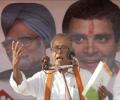
Finance Minister Pranab Mukherjee on Tuesday said the government has taken the calculated risk of high fiscal deficit to help stimulate growth, but would strive hard to bring it down to 4 per cent in the next two fiscals.

Finance Minister Arun Jaitley presented the Budget in Parliament on Saturday.

The immediate revenue loss could worsen the Centre's fiscal deficit, from the budgeted 3.3 per cent of gross domestic product (GDP) to 3.7 per cent of GDP -- a massive 40-basis-point increase. It was stabilised at 3.4 per cent since 2016-17, report Abhishek Waghmare and Dilasha Seth.
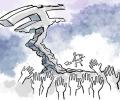
Revenue collection next financial year may be affected, and, along with this, subsidies on food and fertilisers can go up if the war in West Asia drags for long, according to experts.
'We believe that the Budget will take a step towards fiscal consolidation and the fiscal deficit target will be in the neighbourhood of 5.5 per cent as against market expectations of 6-6.5 per cent,' the bank said in its report. The market fears of a high fiscal deficit are based on the opinion that the government would continue with stimulus packages to prop up growth, it said.
India's fiscal deficit, including the Centre and states, would be among the highest in the world and likely to be 10.3 per cent of GDP in the current fiscal and 10 per cent in the next fiscal, financial services firm Goldman Sachs said on Friday.
Had the states not fulfilled their commitment on fiscal consolidation, the overall fiscal deficit would have widened.
Forecasting 'slippage' in budgeted revenue and fiscal deficit targets for the current financial year, the Economic Survey 2011-12 has called for financial consolidation based on structural reforms in government expenditure.

Country's fiscal deficit touched Rs 516,390 crore or 95.2 per cent of the annual target during April-December, the Controller General of Accounts said.

To enable widen the fiscal deficit beyond the permissible limit under the present legislation, the government may have to propose amendment to the FRBM Act in the Finance Bill.

According to the figures released on October 31, the deficit till September had inched down to 65.6 per cent of the budget estimate for 2012-13, compared with 65.7 per cent till August.

State-owned Indian Oil Corporation (IOC), Bharat Petroleum Corporation Ltd (BPCL), and Hindustan Petroleum Corporation Ltd (HPCL) are reportedly incurring losses of Rs 18 per litre on petrol and Rs 35 per litre on diesel, as they continue to absorb rising crude oil costs without increasing retail prices. This situation is leading to expectations of a fuel price hike after upcoming state elections.
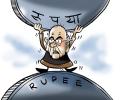
Fiscal deficit has a bearing on sovereign rating of the country as well as the debt market.

Kerala, Tamil Nadu and West Bengal have been fiscally stressed for a considerable period of time, and there are no easy ways to mobilise revenues to meet the cost of the promised freebies, particularly in the prevailing difficult economic scenario, points out M Govinda Rao.
The rise in the fiscal deficit, which is a reflection of the government's borrowing, was mainly on account of subdued tax collection. The revenue deficit also rose to 3.27 per cent, up from the revised estimate of 2.4 per cent of the GDP.

Divestment in BPCL, SCI, Concor, NEEPCO, and THDC would help the Centre keep its fiscal deficit in check in the wake of subdued tax revenues and a Rs 1.45-trillion hit for the exchequer from corporation rate cuts.

The Union government's fiscal deficit further widened to Rs 9.53 lakh crore, which is nearly 120 per cent of the annual budget estimate, at the end of October of the current financial year, according to official data released on Friday. The deficit widened mainly on account of poor revenue realisation. The lockdown imposed to curb spreading of coronavirus infections had significantly impacted business activities and in turn contributed to sluggish revenue realisation.
Centre's fiscal deficit amounted to Rs 114,993 crore (Rs 1149.93 billion) during the first 11 months of this fiscal, which is 79.1 per cent of the revised estimate for this fiscal.
The fiscal deficit for the current financial year has been contained at 5.2 per cent of GDP, lower than 5.3 per cent as was targeted, Finance Minister P Chidambaram said.
A whopping 29 per cent growth in the Centre's fiscal deficit to Rs 1,55,833 crore (Rs 1558.33 billion) or 6.8 per cent of GDP in 2001-02 has made the Comptroller and Auditor General sceptical of the long term target of two per cent by 2006.

Reserve Bank of India (RBI) Governor Sanjay Malhotra stated that preventing second-round effects of supply shocks, where inflation expectations rise due to prolonged disruptions, is the primary role of monetary policy. He also defended the RBI's foreign exchange market interventions, asserting it did not commit to an 'indefensible peg'.
Many ministries couldn't use the allocated funds since it came into force, resulting in much-needed savings.
Credit rating agency ICRA on Tuesday warned that fiscal deficit will cross 4.8 per cent of GDP during 2003-04, as it was projected by the government in the interim budget.
The Centre's fiscal deficit was up marginally by 1.6 per cent at Rs 1,27,975 crore (Rs 1279.75 billion) during 2004-05 from Rs 1,25,960 crore (Rs 1259.60 billion) in 2003-04, despite efforts to cut wasteful spending and push up revenue.

FinCom prescribes scrapping of effective revenue deficit.
India's fiscal deficit for the past financial year ended March totalled Rs 1,44,647 crore (Rs 1,446.47 billion), representing 99.4 per cent of the revised estimate of Rs 1,45,466 crore.

The government has to take difficult decisions in the budget, which can include cutting subsidies to curb expenditure on items like fertilisers and also upping revenues.

India achieved a current account surplus of USD 7.1 billion, or 0.7 per cent of GDP, in the January-March quarter of 2025-26, primarily boosted by robust services exports and increased remittances from overseas Indians, according to recent Reserve Bank of India data.
Riding on improved receipts, the Centre succeeded in containing fiscal deficit to Rs 43,467 crore (Rs 434.67 billion) in the first five months of this fiscal but expenditure rose marginally during the period.
In absolute terms, revenue receipts stood at Rs 9.07 lakh crore at the end of October. For the entire 2019-20, the revenue receipts have been pegged at Rs 19.62 lakh crore.
Reserve Bank of India Governor Bimal Jalan said on Saturday the fiscal deficit remained a difficult problem but overall macro-economic conditions were favourable for accelerating growth.
The total networth of India's 55 billionaires has fallen marginally to $189 billion (over Rs 10 lakh crore) in the past one year, but even half of this amount exceeds the country's total fiscal deficit.

India's fiscal deficit during the 2012/13 fiscal year ending March fell to 4.9 per cent of the country's gross domestic product, compared with 5.8 percent a year ago.

The fiscal deficit in the first three months of current fiscal stood at Rs 2.86 lakh crore or 51.6 per cent of Budget estimates for 2015-16.

The Centre's fiscal deficit, the gap between the government's expenditure and income, stood at Rs 1 trillion during April-May, constituting over one-fourth of the budget estimate for the entire 2010-11 fiscal.
